Join Learnadoodledastic Mailing List

Enter your email address:

Delivered by FeedBurner

Subscribe to RSS Feeds

Subscribe in Bloglines

Add to Pageflakes

Add to   Google Reader or Homepage

Useful Website Links

Saturday, May 05, 2012

Making a case for creating Open Educational Resources for use in Higher Education

To set the scene we'll start with a useful and pragmatic definition of Open Educational Resources from Stephen Downes (although he does not support the idea of an 'official' definition) – Read more here http://halfanhour.blogspot.co.uk/2011/07/open-educational-resources-definition.html
"Open educational resources are materials used to support education that may be freely accessed, reused, modified and shared by anyone."

Background

Inspiration for this post was attendance at the one day MEDEV workshop From curiosity to confidence: sharing what it takes to ‘go open’ with learning and teaching resources. Keynote speaker Kieran McGlade (Queen’s University Belfast) kicked off proceedings with an Introduction to open educational resources (OERs) and open educational practice (OEP). Megan Quentin-Baxter (MEDEV) and Jane Williams (University of Bristol) prompted useful discussion not just on copyright issues in relation to OERs but also on the very important ethical question of consent (i.e consent of lecturers, participants and patients for the re-use and distribution of OERs).

Brigham Young University faculty survey seeks to advance open education through academic libraries
Image Courtesy of opensourceway under the CC 2.0 SA licence

Sangeetha Rajoo and Caesar Wek (Both, Queen Mary University London) demonstrated the good work that they have done creating open educational resources and outlined their approaches and the issues that they have come across. In the final session of the morning Paul Scott (Hull York Medical School) gave an important insight into institutional approaches to developing OERs, emphasizing the importance of planning early from the beginning to ensure all resources do not infringe copyright and that consent is obtained before the creation of resources.

Suzanne Hardy (MEDEV) rounded off the session in the afternoon with many practical tips and advice on tools to use that will aid the development of OERs.

Further Reading

With a business hat on one of the prime motives quoted to justify the creation of OERs is that it is good marketing for the institution and it allows the institution and/or the individual to showcase their skills and knowledge, enhance their reputation and encourage students onto the standard regular courses and programmes that are offered. This may be so, however I have not been overly convinced about the cost effectiveness and sustainability of this approach for the institution and the effectiveness of OERS in being re-used and re-adapted for teaching and learning.

To help improve my understanding and come to an effective rationale to make the case for creating Open Educational Resources for use in Higher Education and beyond I’ve also recently read two articles on the topic. i) Positioning the OER Business Model for Open Education and ii) Extending the Territory: From Open Educational Resources to Open Educational Practices.

Accepting there are merits in the motivation mentioned above, for me it is not yet clear if this alone is a strong enough basis for a Strong OER commitment that fits into the overall strategy of a Higher Education institution and further how it fits in with the notion of still trying to gain competitive advantage over other Institutions who you are collaborating with in a spirit of altruistic educational endeavour. I probably need to examine in more detail the philosophy and ‘success’ of an institution like MIT with their renowned open courseware (OCW) programme (See MIT’s Presidents message about OCW), but attendance at the workshop combined with the further reading has helped me to crystallize a number of reasons that will help make the case for institutional backing for creating and developing open educational resources for use in Higher Education.

The First Argument

The first argument is that as a leading educational institution it is in the public good to share knowledge globally for the benefit of citizens of the world. To quote Susan Oldfield from the MIT OCW website “We do not yet know the full potential of OCW and its ultimate impact on global education. But it is clear to us that by thinking of knowledge as a public good for the benefit of all, and acting on this philosophy through OpenCourseWare, we can make a difference”.
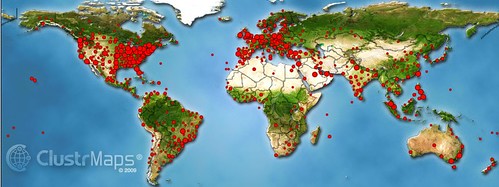
Clustr Map for the Global Education Collaborative Community 11.28.2009 Image Courtesy of elemenous under the CC 2.0 SA licence


The early pioneers had an obvious passion for this and for many others they may just need some encouragement by other practising colleagues to convince them that contributing to global education is a wonderful thing.

To stiffen this mentality up it could be argued especially in the UK that given that lecturers and the institution are funded in large part by the public purse then lecturers are honour bound to spread their educational resources to the wider public.

Belief in the value of Open Educational Practice is the Key

Open Educational Practice when defined is often closely intertwined with Open Educational Resources, for me it is much wider than that. It is sharing and engaging widely and openly. It involves network learning and making use of all the wonderful social networking tools at our disposal to engage and connect with other people on a local, national and global basis. This video Community as Curriculum and Open Learning from Dave Cormier and this video Networked Student from Wendy Drexler best help to explain the concept.
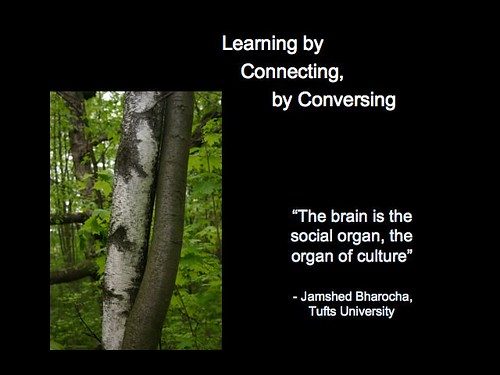
UNH Talk Slide17 Image Courtesy of bgblogger under the CC 2.0 NC licence

Many individual lecturers in Higher Education especially at this time may question the mentality of embracing an open educational ethos and making resources that they create free, open and available for use and re-use by both teachers and students. To persuade unconvinced staff, to me it is essential that staff first buy into the notion of open educational practice. Once convinced, the notion of creating open educational resources will naturally become part of the open educational mindset.

Having myself been exposed to the open educational concept primarily through the great connectivist movement (see what is connectivism?)  my own sharing behaviour has been changed as I have been convinced by the enlightened early believers of the merits  of being an active participant in a wider national and international open learning community. The massive educational benefits I have freely received has encouraged me to contribute my own knowledge skills, ideas and opinions freely and openly thus playing my part in helping others, as others have helped me.

We need to emphasize that the materials are free and open in the context of education and are for non-commercial gain with you the creator maintaining control of all aspects of copyright including accreditation and sharing and re-use restrictions. This is ideally done using a Creative Commons license, but part of the preparation will include ensuring all material used has no copyright restrictions and that ethical, moral and legal consent for the inclusion of third parties in for example video resources is obtained.

Mitigating the effort of creating OERs

I question the cost effectiveness and the sustainability because it is not monetarily cheap to produce sophisticated specific resources or timewise cheap to adapt and prepare materials for use as an OER. However, if you are persuaded by the need to act in the public good, the obligation to make the most of your publicly funded time or you really can see the massive advantages of giving and receiving open educational resources and sharing knowledge and ideas as part of a global education community, then with some preparation and clear intent at the outset the job of creating OERs for use in your regular teaching and learning and then for further sharing and re-use can be made easier in a number of ways. Consider the following:

1. Within most Higher Education institutions there will be an OER Champion. It will be important to work with them and within your own institutional guidelines and policies. There are many legal and ethical issues to consider. Your OER Champion mindful of the circumstances at your institution will be able to offer time saving guidance and advice and possibly a clear checklist of things you need to do to prepare resources for open educational use.

2. Addressing key legal and ethical issues mentioned above before starting development of an OER will include i) ensuring that you are the copyright holder or that you have copyright clearance to offer certain material  within an OER ii) clearly stating the terms upon which you as copyright holder will allow the OER to be used, shared or re-used (a creative commons license makes this a simple process) and iii) gaining consent of participants in OERs before creation of said OERs (and with a clear explanation as to its purpose and use).

3. With an OEP mindset you’ll be more inclined to take advantage of OERs produced by others. Your eyes will be opened to a wealth of material freely available. This will inspire you to understand what is possible and encourage you to contribute yourself when the time is right.

4. There are many free tools out there to help not only the development of OERs but resources for your own regular teaching and learning. Once again opening your mind to these tools will further encourage you to understand that with good planning and preparation making resources available freely and openly for use and re-use although requiring some effort may not be too onerous a task.

Practical Help

During the MEDEV workshop Suzanne Hardy signposted some great tools for sourcing open educational resources during the workshop.  Some useful tools highlighted are listed here.

OERs in Action

Here are a couple of useful examples of OERs that i am familiar with:

And Finally Dissemination

There will be many OER Repositories such as Jorum to upload your resources too, but if you want to try and spread the word about your OERs far and wide this search engine optimisation guidelines article by Dr Vivien Rolfe and Dr Simon Griffin uses the DMU Sickle Cell Anaemia project mentioned earlier to illustrate a step by step approach to gaining maximum exposure for your resources.
PS:If you don't know where to start with connectivist teaching and learning, contact me and i'll suggest a suitable starting point.

Sunday, January 29, 2012

Articulate Presenter: Adding Voiceover Sound

In a previous post we looked at how to include voice-over sound in PowerPoint presentations. For those that also have access to the Articulate Presenter PowerPoint Add-In there is the opportunity to add sound to an enhanced presentational format.

This two part series demonstrates how add to add voiceover sound to Articulate presentations and highlights a few basic points about the files and folders that are generated.

Part 1: Adding Voiceover sound to Articulate Presenter - Adding Sound, Previewing and Publishing


Part 2: Adding Voiceover sound to Articulate Presenter - Files, Folders and External Sound

Saturday, December 31, 2011

Adding Voiceover Sound to Powerpoint

I have created a 4 part series of videos demonstrating and discussing how to include voice-over sound in PowerPoint presentations. For those that are new to PowerPoint, electronic presentations or are slightly technophobic in these matters hopefully these videos will be useful to you.

Part 1: Adding Sounds


Part 2: Summary and Considerations


Part 3: Audacity


Part 4: Adding External Sound Files and Final Summary


Thursday, September 23, 2010

HOLD THE FRONT PAGE - PLE's need Teachers

Call it a PLE if you like, to me it is connectivist learning. Other terms that i can identify with are Dave Cormier's 'Community as Curriculum' approach and Wendy Drexler's elucidation of Networked learning in the 'Networked student model' (video) .

I agree with Jenny Mackness blog post on Curation and Balance in that it is the process that is of most interest and relevance when trying to explain to staff and students the benefits of 21st century connectivist learning. I think however the terms PLE and PLN are with us to stay and so an appreciation of the differences between the terms is useful. From the various blog posts it would seem that the consensus is that a Personal Learning Environment (PLE) is more concerned with tools and technology and that Personal Learning Networks (PLN) are more concerned with connections to people. I agree with these distinctions and I like Vahid Masrour's (PLE, i think i got it (for me, anyways) concise view of their respective functions.

  • PLE - "My PLE is where I store all my “keys” to the network. The PLE takes me to my PLN through various gates and paths." and later he says "PLE's are nice, and useful, but they're the ticket and ride, not the destination. The destination is the PLN."
  • PLN - "One of the key concepts for me in a PLN is that learning is a social activity.", "The PLN is then more akin to a community, but with much looser connections, described in the literature as “weak ties”. He also states "The key aspect here are the connections, and what I can do with them, in the sense of doing something with them, not just benefiting from them."
PLE's and PLN's in context
Before I move onto the main theme of this post - The role of the teacher in a PLE, I wish to just talk about the context of PLE and PLN use. I can think of three different contexts where a PLE-PLN will be in use:
  1. Unconsciously - Those who without prior knowledge of the terms PLE and PLN learn from online pursuit of their interests combined with ongoing general social interaction.
  2. True self directed independent learners who have naturally seen the potential of connective technology to enhance their own learning and understanding OR initially teacher supported users who are now confident working and learning autonomously in a self directed way.
  3. Teacher supported PLE's and PLN's
As educators who see the learning benefits in a PLE/PLN approach then i think we need to recognize the importance of teacher supported PLE's and PLN's and the need to educate both teachers and students in order to promote this approach to learning.

Balance and the Teacher as Curator/Facilitator
Jenny Mackness and Wendy Drexler both highlight the issue of balance (in many respects), but notably in the issue of teacher intervention and getting the right balance between supporting and scaffolding the learner experience and letting students independently develop and grow their own PLE's and PLN's.

This excellent post by Leigh Blackhall Regarding George Siemens curators and George's subsequent excellent response breaks down possible roles involved in networked learning that the teacher may be classified as (Expert: Someone with sustained contribution to a field, Teacher: experts with authority, Curator: play the role of interpreting, organizing, and presenting content, Facilitator: able to guide, direct, lead, and assist learners, not necessarily being a subject matter expert.

I note that George in his Networks, Ecologies, and Curatorial Teaching post likes the idea of curator to reflect the role of network administrators/organisers in a networked learning environment. Previously I have always used the term 'teacher as facilitator'. After reading George's definitions i believe curating is probably more apt. In a teacher supported PLE/PLN the teacher will probably do both roles.

Further to this I see the PLE-PLN as part of a learning strategy that runs alongside a more deliberate and social and active learning approach where more contrived learning tasks and activities are instigated to improve connectedness. It's all about context i think, but I note this may go against the grain of leading connectivist thinker Stephen Downes whose views are explored in this blog post - The groups and networks debate (I shall read more on this later).

I see the role of the teacher as curator/facilitator as absolutely critical to helping students to appreciate and then develop the PLE-PLN approach to learning. It seems natural to me that intervention can be gauged on a continuum whereby new PLE-PLN learners are quite heavily supported and this support gradually diminishes as the learners evolve into confident autonomous and self directed learners.

Making PLE's and PLN's work Better

Vahid Masrour finishes his blog post with these questions/observation. "I guess my next question then becomes: why focus on PLEs? Shouldn't we be trying to figure out how to make PLN work better?"

I think he has a good point. Development of your PLE is about working with technology, refining your use of tools to give you more keys or more efficient access to your network of people and resources. This process alone will enhance connectivist learning skills, but it is in addressing how to make PLN's work better that enhanced learning can occur. i.e how to improve connection making and strengthen connections.

We can explore this more at another time, but the main themes worth exploring in this regard are.
  1. Learner centered pedagogic development for teachers
  2. Technological and online skills and practices development for teachers
  3. Technological and online skills and practices development for learners
  4. More use of web conferencing for live interactive synchronous learning activities.
I'' leave you with an excellent book - Helping Students Learn in a Learner-Centered Environment: A Guide to Facilitating Learning in Higher Education, which will serve as a guide for face to face and online facilitating and focus thinking on how this pedagogic approach can be adapted using the online technology available.

#PLENK2010

Friday, September 17, 2010

A Deliberate and Effective PLE

Initial reading that has help me to formulate my opinion on this topic is the excellent Developing Personal learning networks for open and social learning article by Alec Courous who explains the rationale for choosing a primary free and open learning environment and describing the course facilitation model to promote an open an social personal learning network, John Mak's Research into the Design and Delivery of MOOC blog post which contains a number of prompts in relation to open and social learning compared with the more structured and traditional way of learning, Dave Cormier's 5 points about PLE'S and PLN'S which gives a good overview of key points on the topic and Scott Leslie's Mother of All PLE Diagram Compilation.

Thinking about my own PLE in relation to the reading led me to developing my own PLE Model. The thinking behind the model is outlined below the following diagram.


Questions that crossed my mind were:

1. Is your PLE Deliberate? By this i mean has your PLE just grown organically by adding and experimenting with different services or have you deliberately organised and designed your PLE to suit your learning Purpose.

2. What is the Purpose of your PLE? which leads onto the question...

3. What model of a PLE fits your purpose? (need to review PLE Models)

When considering Question 2 further questions come to mind such as:

4. What do you do in a PLE?


5. What is learning in a PLE?


Once you have a better understanding of what you do in a PLE, How you learn in a PLE and what the purpose of your PLE is you can in a more informed way address the question

6. What technically do i need to do to make my PLE Effective?

So - What about my PLE, is it Deliberate, does it have a purpose
In asking myself is my PLE deliberate the simple answer thus far is NO. Yes i do have a collection of tools that i use to help with my learning and maintaining personal connections, but previously i have not thought through clearly what i hope to achieve with my PLE. Until now most of my learning is driven by my immediate needs, the galvanising effect of being enrolled on a formal course or involved in informal but Studious and intentional courses such as this MOOC and serendipitous casual learning.

When thinking about the purpose of my PLE it strikes me that i have needs for a number of distinct learning situations, but i shall concern myself with my primary interest which is learning and education and in particular social, active and participatory learning.

Towards a Deliberate and Effective PLE
If we start with the premise that when creating a deliberate and effective PLE you are signed up to the notion you can enhance your learning by learning in an open, social, participatory, sharing way then at the most abstract level I think of what you do in a PLE as the 3x3.
1. Collate, filter/sort and share TOPIC/CONTENT information
2. Collate, filter/sort and share PERSONAL ACTIVITY
3. Collate, filter/sort and share NETWORK ACTIVITY
By actively contributing to these activities you will be contributing to your own and others learning. It can quite a demanding business, but being organised and deliberate will help and being kind to yourself in recognising that you may not have all the time you would like to contribute fully will help as well.

Practically - What do you do in a PLE?
It was interesting perusing the diagrams at Scott Leslie's Mother of All PLE Diagram Compilation, but quite overwhelming at times. Nevertheless it did help me consolidate what i believe occurs in a PLE and consequently has now given me a model to follow in constructing my own deliberate and effective PLE.

To simplify and understand what you do in a PLE I have broken down the key elements to SIX key activities plus your CONTROL center of Choice. We'll call this the CONTROL PLUS SIX model. Linked into this model is the recognition that the web based tools that you use in this model will have multiple uses and can fit in any of the six activities depending on your own learning purpose. The six activities that i have identifed are 1. Data Gathering, 2. Publishing, 3. Communication, 4. Collaboration, 5. Reflection and 6. Planning.

I think most activities can be bracketed under these headings. I welcome any thoughts as to whether these broad categories do indeed capture the range of activity that ensues in a PLE.

The Control Plus Six PLE Model

0. The control centre: Whatever you use to pull together all the collating, sorting and sharing of topic/content information, personal and network activity. May be a combination of tools, not neccessarily just one. For example a Wordpress blog, Integrated Google tools, Personal Blog with Tweetdeck and RSS Feed reader.

1. Data Gathering : (Inbound Activity) - e.g. diigo, delicious social bookmarking, google search, network tweets, network blog posts, facebook links
2. Publishing: (Outbound Activity) - e.g. blogging, creating multimedia, presentations, articles
3. Communication: (Inbound and Outbound Activity) - e.g. discussion forums, tweeting, email, social networking (i.e facebook), web conferencing, instant messaging
4. Collaboration: (Inbound and Outbound Activity) - e.g. wikis, google docs, project collaborations, presentations, research, article writing
5. Reflection: (Neutral - Home Activity) - e.g. blogs, wikis, notes (facebook, diigo)
6. Planning: (Neutral - Home Activity) - e.g. google calendar, project management (i.e basecamp)

#PLENK2010

Saturday, July 24, 2010

Digital Participation, Digital Inclusion and Social Learning

Digital Participation - Why?

Attended the 'Measuring the Unmeasurable: Digital Participation' Seminar at Birmingham University on Monday 19th July. I was unsure as to what to expect. My motivation to attend stems from my interest in informal online learning and how connectivist methods of online learning can be used to promote digital participation. Also interested in the notion of measuring participation. The purpose of the session was to provide a forum for discussion of the meaning and measurability of digital participation
. Key objectives of this initiative from Birmingham City University was to:
  • To start up a continuing dialogue between researchers, activists and policy-makers about issues of research and measurement.
  • To identify key concerns about the meaning and value of digital participation.
It would seem and i agree that widespread digital participation is a desirable aim for the government of any country. Desirable if you are a government that wishes to be inclusive and not have certain sections of the nation excluded from modern communication. Indeed here in the UK the topic has attracted interest because the previous government identified a goal of increasing digital participation. The new coalition Government also shares this ambition. More information can be found here at the raceonline2012 website. The importance of digital inclusion and digital participation for the Government are emphasised by Martha Lane Fox, the governments UK Digital champion:
"We need to be ambitious, ‘think internet first’ when we design services, and put the needs of the hardest to reach at the heart of industry, charity and government. There is a social and moral case to make sure more people are online but there is a clear economic case too. We will all be better off when everyone is online." July 2010
Throughout the seminar i kept asking myself why - Why are the Government pushing this, What is their motivation, What is their Vision. Martha Lane Fox offers this:


and the seminar introductory text offers this:

"Lord Carter presented the final Digital Britain report in June 2009 (. The report highlighted the need to engage a wider cross section of the public in going online; identifying that such engagement would result in the efficiencies and economic benefits expected from living and working in the digital age. It is quite a detailed report and i have not had a chance to read it yet. As part of the digital participation agenda the following were identified as important topics to address:
  • Digital Life Skills
  • Digital Inclusion and
  • Digital Media literacy

Overview of Proceedings


Speakers at this event included:
  • Professor David Macguire Birmingham University, Pro-Vice Chancellor Corporate Development
  • Paul Watson – Director, Digital Economy Hub for Inclusion through the Digital Economy
  • Catherine Bunting – Director of Research, Arts Council England
  • Alison Preston – Senior Research Associate, Ofcom
Proceedings were kicked of by Professor David Macguire who emphasized the point that we are now part of a knowledge sharing economy and that through the development of digital technology their has been an information revolution, but without effort to achieve digital participation throughout the country then we will perpetuate the digital divide that exists, whee currently 12.5 mullion out of the 65-70 million will not be participating.

Keynote Speaker Paul Watson told us about the Social Inclusion through the Digital Economy
. (side) research project that looks at problems of accessibility, connection at home and in society, transport and capitalizing on the emeregence of creative industries through the eyes of technologists, sociologists, business leaders and end users to provide scalable, sustainable and economically viable solutions. This project goes much wider than just ensuring that people have access to the internet, but does encapsulate good practice in promoting a model of joined up thinking on the subject of digital participation. This short video explains the sort of thing Paul Watson and his team are researching:


Alison Pearson outlined what Ofcom who had been commissioned under the Cartrer Report (2009) to collect statistics on digital participation outlined
the approach they have taken to measuring digital participation. This included measuring:
  • Reach: Who uses the Internet, Where do they use it, How do they access it.
  • Breadth: The ranges and types of Activity
  • Depth: User contributions and Content creation.
Part of the role of Ofcom is to them measure the social and economic impact i.e. The extent to which participating online had improved social contact and economically whether savings had been made. Additionally Ofcom looked at the appetite for take up amongst non users and the reasons why some people do not have the internet at home.

Whilst the final speaker Catherine Bunting had some worthwhile incites into using cluster analysis and segmentation research methodologies to get a firm grip on who is participating in arts based events (off line) and lessons can be learned and applied to digital measurement I was much more interested in How do we get people to participate, what does participate mean or simply asking the question why should you/me participate.

Presumably others felt similarly as the afternoon workshop by Jennifer Jones on Depth
was by far and away the most well attended.

Why is participation important? - Some thoughts!
Well too me it depends on who is answering the question, but the bottom line to me is that participating online promotes social learning and learning in all its forms is a strong foundation for progress within a society. There was a strong feeling i got from our discussions on the day that one of the strong motivations was to save the government money by moving services online - which is all fine, dandy, proper and good but whoever is driving this vision must be driving with a passionate belief that being a digital citizen allows the individual and society to develop and improve both from a social and economic point of view.

If we leave the top end knowledge workers to one side, to encourage full digital citizenship there needs to be a social, life benefit to participating which will attract interest from all levels of the community. To the individual if their are benefits to be gained economically or in terms of convenience then this will indeed be one strand of the motivation. If digital participation can have a link to offline activities that foster community and social activities that would be another important and worthwhile strand. Participating online, mixing and socializing will inevitable lead to informal social learning, but there are also fantastic opportunities to support people online who are looking to learn specific skills and competencies.

So underpinning effective and inclusive digital participation will be education and especially education in the new media literacies that are required to function effectively in a wide range of activities on the web. This may require a change in teaching mentality that embraces new media technology in schools. The video below will set the scene for creating digital citizens for the 21st century.


Alison Pearson of Ofcom talked of the importance of media literacy and on that subject here is a fantastic resource from Ruth Howard one of the participants of a recent CritLit2010 worldwide online course pondering the critical literacies required for the online networked learner. A lot of links here to educators around the world that are discussing and debating how the web can foster social and informal learning.

To wrap up i would say obviously that massive investment in kids education from 5 upwards is imperative. Reading and writing would be a good place to start (and overcome the nonsense of kids in the UK not being able to read and write effectively as they move into teenage and adult life), followed by good grounding, good experience and good discussion on how to participate in a social media driven web world. On that theme Howard RheinGold's Participatory Media And The Pedagogy Of Civic Participation presentation is a comprehensive look at participatory media. For existing adults i do believe the learndirect type centers offer good potential to develop digital and community participation. Having worked in a similar drop-in style computer center for Stafford College many years ago - it was very effective in teaching the basic skills of computing and having a focal point in the community.

Development of other online social enterprises such as those run by Stuart Parker at We Share Stuff and Comunity focused Social Media Surgeries whose aim it is to take make it easier to find and run social media surgeries to support community groups, local charities and local active citizens are welcome initiatives..

Another useful website to help in upgrading basic computer skills is Online basics
That's about it from me - i think you can see that my view is that an aim to improve learning for all and develop better educated citizens is the best way to approach the aim of making digital participation inclusive for all.

I leave you finally with some interesting websites from outside of the UK that may help inform thinking on this subject - One from America The Institute of Digital Inclusion and one from Australia education.au whose aim is to build bridges between educators and technology to help make technology accessible, easy to understand and simple to use.

Sunday, July 11, 2010

Connectivist Learning #CritLit2010 #CCK09

After reading George Siemen's post on Connectivism taxonomy and John Mak's response I compared the points expressed with the critical literacy taxonomy that i had published in my last blog post and with my own views on connectivist learning. I have subsequently created a wiki page to develop a Critical Literacies Taxonomy and a wiki page that looks at Connectivist Taxonomy Linked to Critical Literacies. I'd welcome any input to develop and discuss the issues as a group from interested colleagues.

If we start with some feedback on George's proposed connectivist taxonomy. Firstly I agree with the suggestion from Brad Hodge that metacognition could come in as early as connection forming. Maybe at Praxis level metacognition encapsulates more thought about the network. As John Mak asserts maybe in the "chaos and fuzzy dynamic" connnectivist online environment it is difficult to "measure competency in a discreet manner" with regard to the development of a connectivist learner. I based my subsequent Connectivist Taxonomy Linked to Critical Literacies, on John's further proposal that a dynamic n-dimensional (mxn) model of taxonomy may be more suitable. You'll notice from the model that one further distinction i have drawn is that the connectivist taxonomy appears to progress from individual knowledge development and then move on the network knowledge development and i thought it was important to emphasize that distinction.

The other strong points to emerge for me were the 1) excellent point raised by Avi Charkam and the role of the teacher in the taxonomy of connectivist learning and 2) John Mak's highlighting of the social and emotional elements that contribute to learning e.g. emotional control, self awareness, self confidence, motivation, social skills and interpersonal skills, social elements (social awareness, ethics, intelectual property awareness etc). Perhaps a matrix model may help in this regard

On a side, but equally relevant issue these two points struck a chord with me as my in my masters dissertation i proposed a model of distance learning termed SCORE 2.0. This model was inspired by connectivism, wherby i see not just the fantastic potential of asynchronous communication to aid informal learning, but i see the interactive synchronous classroom sessions as a fantastic medium to connect people much more strongly than asynchronous alone. I see the teacher being very important in this model of distance learning - not just in delivering, but in planning the whole learning experience. Connectivist, active and social learning runs through the heart of the model and the teachers role is to engineer and support development of a connectivist mentality. It would seem that the approach to connectivist learning is that it is strongly self directed learning. I believe that connectivist learning can be viewed along a continuum from heavily supported learning to a fully self directed learning and that the teacher has the important role if giving the appropriate support at various times along this continuum.

The key findings of my masters disseration were that the online synchronous classroom when used in conjunction with varied learning activities can be a motivating and engaging environment in which to build a community of learners. Supporting ‘Web 2.0’ technologies play an important part in supporting the community of learners and in helping to develop learner autonomy. Vital to the successful implementation of the model is an appropriately trained and motivated teacher. For those interested here is my dissertation.

Sunday, July 04, 2010

Network Learning: A Taxonomy of Critical Literacies #CritLit 2010

From the discussions and reflection so far in the CritLit 2010 course I set out to build on my earlier blog posts and develop my own understanding of critical literacies for the 21st century networked learner. Encouraged by Ruth Howard and John Mak i initially considered developing a taxonomy of literacies in the form of a visual model to capture the elements identified by the Critit2010 group. In considering what to include and how to represent it i started to reflect back on the course materials, presentations and discussions.

Foundational Critical Literacies

Strange as it may seem i have not seen many of the presentations related to the weekly topics, but have worked from the readings and the subsequent blog postings of others. It was good then to work my way through Grainne Conole's presentation on one of the key foundational literacies (as proposed by Stephen Downes) which came in week 1 on Cognition.
Simultaneously i was trying to appreciate the significance of what i would call the other key 'communicative' or 'signifying' foundational literacies of syntactics, semantics and pragmatics and wondering whether these foundational literacies can be worked into my proposed visual model. An example of what i had in mind can be seen is this visual model of Bloom's Taxonomy.

The importance of the other key foundational literacies of 'appreciation of context' and the 'ability to recognise and adapt to change' quickly became apparent in Grainne's presentation. Grainne pointed out that the context of education is itself changing. We have an explosion of new and ever changing technologies, ubiquitous networked access (mobile and broadband) and an abundance of free online tools and applications.Additionally learners themselves are changing - they are growing up 'digital' - i.e technologically immersed, task orientated, group based and just in time mentality and comfortable with multiple representation. This context facilitates new technological approaches that move from a content driven, transmission passive recipient model of learning to a more participative, active and social way of teaching and learning. In this context the six key foundational literacies are going to be much more important for networked learning. Grainne points out that although the technological environment in the 21st century fosters a myriad of affordances (action possibilities) for a learner - the affordances for an individual will be limited to their capabilities - i.e their critical literacies.

Grainne suggests that the technological affordances at all levels (written words and numbers, 1st wave technology - phone, radiot, tape,TV, 2nd wave technology of computer networks, mobiles, the internet) are communication, connection, interactivity and representation and that practices evolve depend on the characteristics of the users (e.g. preferences, interests, skills, context).

We can see for networked learners in the 21st century an example of how critical literacies are important when we consider Grainne's example of using the microblogging service 'Twitter". Examples of use include posting queries, commenting, gathering opinions, sharing ideas, brainstorming, maintaining social presence. We'll just consider some of the issues of using this service that were raised and how they may relate to our foundational critical literacies. Issues identified were:

i) Your 'a-ha' moment (cognition - ability to infer)
ii) is it the right network (context)
iii) your digital voice (syntax, semantics and pragmatics i.e how you communicate)
iv) Inappropriateness (syntax, semantics, pragmatics cognition, context and maybe change)
v) Personal/Private (context and maybe change)
vi) Too much twittering (cognition and maybe change)
vii) Use with other tools (cognition, context and maybe change) and
viii) A passing fad (cognition context and maybe change).

I'd be interested to hear others view on how i have tried to relate these foundational critical literacies to issues raised in twitter. At times i was not sure i could make a clear relationship. Where i feel more comfortable is in trying to align some of the practical (more tangible) literacies identified during this course and positioning these in some sort of schema, taxonomy or model that may inform the inclusion of these critical literacies as part of teaching and learning.

A taxonomy of Critical Literacies (skills) for the networked learner

I have so far collated the information below, i have put it into a semi visual format, but repeated in text format below. Still lots to reflect on, but maybe others would like consider if the top level categories need expanding/changing and what is missing from this taxonomy of critical literacies. Critical thinking skills are considered to be brought to bear on all the critical literacies from 4-7. Final thought as i write this - should these categories be referred to as skills so as not to be confused with our underlying foundational critical literacies.


1. Basic
* i) Reading/Writing
* ii) Numeracy

2. Life
* i) Management of Time, Workload and Prioritising,
* II) Self-Efficacy

3. Computer
* e.g. ECDL - European Computer Driving License

4. Web -
* 1.Managing your Digital Identity - SM
* 2.Recognizing Authenticity and Legitimate Authority - SM
* 3.Emotional and Social Intelligence (Relationship Building and Development inc trust and respect) - JohnM
* 4.Self Expression and Participation - SM
* 5.Wayfinding behaviors and Strategies in Large Virtual Environments – JennyM
* 6.Ask Questions - Think Critically! JohnM

5. Learning
* 1.Interpreting Visual Data RH
* 2.Information management - Network Student Youtube Video
* 3.Self reflection, self-directed learning (with learning agenda, experimentation & practice – JohnM
* 4.Concise, reflective expression and inquiry? . – JohnM
* 5.Appreciating the impact of Complexity Theory? – JennyM
* 6.Literacy of Memory (Storage of data/knowledge/connections –SM
* 7.Storytelling - X28

6. Teaching/ Professional Development
* to explore

7. Research
* to explore

Sunday, June 20, 2010

Getting Anchored in My #CritLit 2010 MOOC

Consolidation

When I started the Critical Literacy 2010 course, I started late and was not exactly sure what the major focus of the course was. In my mind the dominant thought was that this was a course that was primarily concerned with Critical Thinking Skills. Reflecting back at the outset, the course details did outline that:
"Content for the course is being drawn from the presentation Pedagogical Foundations for Personal Learning This presentation provides a frame for an understanding of the critical literacies required in a networked learning environment. Briefly, the elements are as follows: i) Syntax, ii) Semantics, iii) Pragmatics, iv) Cognition, v) Context and vi) Change."
During the course, discussion has emerged around the topic of critical thinking and many of the participants have gone on to suggest practical critical literacies that learners in a networked learning environment need to develop. The six week course as it suggests in the course details does also indeed follow the course themes weekly and these provide a background to the practical critical literacies which are being discussed on the course. I am much more comfortable discussing the practical critical literacies as i previously have not looked at all deeply at the underpinning elements of communication and thinking that are the bedrock of this course. I have not been able to attend the online synchronous presentations and i have not looked at the recordings (included here) yet either:
Impetus to learn more about Philosophy and Communication

Whilst preparing this blog post it seemed that although i believe i have something to contribute to the course that my main focus should be to ensure that i have good (better) grounding in the main underpinning topics and themes. This was a deviation from my intention which was to peruse various blogs from the CritLit 2010 course, looking for further discussion of literacies that might be deemed critical (as in imperative). Instead inspired by Ruth Howard's Blog post Self as a locus of Learning I linked to the following article on the pros and cons of postmodernism. Ruth was directed to this resource by the industrious, forthcoming and very interesting blog postings of John Mak. John's recent postings relating to the topic of critical litercaies include:
Reading the article on the pros and cons of postmodernism.gave me the impetus to get a brief grounding in Philosophy - A subject that i have not previously explored in any great depth. What i discovered from Wikipedia was that "17th century philosophy in the Western world is generally regarded as being the start of modern philosophy,", generally known as the Age of Reason. I learnt that this era was followed in the 18th Century by the Age of Enlightenment. The Age of Enlightment preceded the 19th Century Modernism philosophy, before the 20th century philosophy of Postmodernism came to the foreground.

Looking at the main themes of the course, communication is the nub of all the critical literacies being considered and therefore an appreciation of Linguistics, the study of natural language is a useful attribute. Important to note that linguistics can be divided between the study of language structure (grammar including syntax) and the study of meaning (semantics and pragmatics). Within the field, linguist is used to describe someone who either studies the field or uses linguistic methodologies to study groups of languages or particular languages. Outside the field, this term is commonly used to refer to people who speak many languages or have a great vocabulary. Wikipedia 2010.

A closely related field concerned with the general study of signs and symbols both in language and outside of it is Semiotics and whilst considering the topic of pragmatics in relation to a networked learner living in a multimedia environment it seems that communicative elements are going to be more than just the written or spoken word.

The Critical Literacy Pyramid

Since the last time i blogged i have perused a few more postings (not as many as i would have liked) and have been considering all the different Critical literacies that have been mooted. In trying to make some coherent sense of them i started to categorize them into top level literacies and categorized them accordingly. This needs thinking through a lot more,but in trying to catalogue them i have been considering a critical literacy pyramid model. Thus far i have captured the following mooted critical literacies and have categorized them thus:

  1. Basic Literacy - Reading and Writing
  2. Life Literacies
3. Computer Literacy (Digital Literacy - María Fernanda Arenas) – For example Completing an ECDL certificate could be evidence of this
4. Web Literacy - Navigating the Web including use of social media and appreciation of cultural, ethical, social and legal issues
5. Learning Literacy – Appreciation of how to use Web 2.0 tools and technologies in combination with various learning theories and strategies
  1. I observe data visualisation as an emergent critical literacy - Ruth Howard comment
  2. Information management mentioned as a critical literacy Network Student Youtube Video
  3. Self reflection, self-directed learning (with learning agenda, experimentation & practice), and relationship building (same as 2) John Mak
  4. Would that be the critical literacy that I also aspire to – concise, reflective expression and inquiry? . – John Mak
  5. Is a critical literacy for networked learning to know something about Complexity Theory? - Jenny Mackness
  6. Literacy of Memory –Steve Mackenzie
  7. Would another critical literacy be ASKING QUESTIONS? . – John Mak
6. Teaching Literacy - Appreciation of how to use Web 2.0 tools and technologies to create and foster learning activities
What about Critical thinking? - see below

I intend to turn this into a diagram at some point. If you can imagine this as a pyramid with 1 at the bottom.I envisage perhaps a set of critical litercies that logically build on the preceding literacy. I apreciate that there colud be some overlapping/fuzzy areas especially maybe beween 5 and 6. Missing from the list is critical thinking which i'd have as an external force from level 4 onwards, (maybe earlier?). I need to think a lot more about it. This is my first stab, i am sure there are other top level literacies and many many more sub literacies ( or maybe not - maybe the list needs to be pruned or merged already). The main thing i wanted to do was to identify some top level literacies, so that all those literacies mentioned can much more easily be related to their purpose.
María Fernanda Arenas wrote a very interesting blog post relating pragmatics to digital literacy and along with Ruth set me off on this quest to know more about the underlying principles of communication and also increased my interest in trying to categorize critical literacies as i have never liked the term 'digital literacy' - it just conjures up images of zero's and one's to me.

What about Critical thinking?Again
Note that this blog post has drawn uncritically from Wikipedia for ease of reference. I generally find Wikipedia a reliable place to get initial descriptions, definitions and overviews from which i can delve into more deeply at a later date. I have found that i have used my blogging in this course more as a storage place for useful links for latter reference. By writing a blog post though i feel as though i have engaged much more with the material in trying to weave the links into a coherent written piece and i love the easy accessibility in retrieving this information (my learning) at a later date. Blogging is great for capturing the learning?

Sunday, June 13, 2010

Critical Literacy – The Struggle Moves to a Different Arena – My Arena #CritLit2010

A snapshot of discussion around the term ‘Critical literacies’

The topic of what is actually meant by Critical Literacy has been raised in a number of places. Heli Nurmi an educationalist with many years experience has some great blog posts around the topic of critical literacy in this course and asks the questions “are we going to learn anything new, will we learn about new knowledge building, new media literacies (yes, but what?) or is it only technology which develops?” Heli’s three initial blog post give plenty of food for thought:


To guide others on the course Ulop O’Taat highlights the following text with this signposting - So Ken, if you and others are struggling with what is meant by critical literacies in this course, re-read the opening moodle page.

“Critical, as the course is not just about finding out how to use the latest technologies for learning, but to look critically at the Web and its underlying structures. Literacies, as it is more about capabilities to be developed than about the acquisition of a set of skills”.

Ken Anderson in his post on Critical Literacy had previously highlighted his struggle to understand what is meant by Critical Literacies in the context of this course. He identifies two themes from the course information:

  • CL: literacies critical to functioning in a PLE. This definition suggests tool familiarity
  • CL: abilities related to critical thinking, reading, writing i.e. logic skills, syntax etc. as noted in the course outline

And makes an additional observation about the course

  • What I have really found interesting is Kop’s statement that the heart of the ‘course’ is about who controls access to information. Is this what this ‘course’ is primarily concerned with? Those that control the means of distribution (of information)… Will this be a course in Marxism?

My own sense-making of the term ‘Critical Literacies’ and my subsequent learning strategy

I more or less identified the same two strands as Ken, which i referred to in an earlier blog post. In trying to establish what is meant by critical literacies in the context of this course I focused on what I considered to be the two most relevant meanings of ‘critical’ that come to mind. These being:

  1. Critical as imperative. i.e. imperative literacies to have
  2. Critical as in being analysed and evaluated i.e. Literacies that analyse and evaluate

Additionally mindful of the stated aims/purposes of the course I also was aware that i need to consider the following element of criticality.

3. Critical as in looking at (analysing and evaluating) the Web and its underlying structures: i.e. sing traditional Critical thinking skills to analyse and evaluate the web and its underlying structures.

It seems to me that there is already a well established set of generally agreed critical thinking skills – therefore in relation to point 2 above I think the question to be pursued is “What technologies will best facilitate traditional critical thinking skills?”.

With regard to point 1, 'critical' as imperative seems to me to be the most important thing to focus on for the self directed learner in a networked personal learning environment and so far on this course the following critical literacies have been offered from the floor or have been found by me in text or video content that i have perused: My intention is to continue to trawl through the CritLit2010 opinions and offerings to add and then to refine the list:

  1. Management of Time, Workload and Prioritising –Jenny Mackness
  2. Relationship Building and Development – John Mak
  3. Wayfinding behaviors and Strategies in Large Virtual Environments - Jenny Mackness
  4. Literacy of Memory –Steve Mackenzie
  5. I observe data visualisation as an emergent critical literacy - Ruth Howard comment
  6. Information management mentioned as a critical literacy Network Student Youtube Video
  7. Emotional and Social Intelligence – John Mak
  8. Self reflection, self-directed learning (with learning agenda, experimentation & practice), and relationship building (same as 2) John Mak

So i plan to continue looking at themes of the week, but ultimately at the end of this course i hoped to have a clear idea of the emerging critical literacies (as in imperative) that a networked learner should develop. Maybe i should put this list in a wiki for all to add to – need to get this blog post finished and then have a rest first J

With regard to point 3 and issues of power and control, i shall leave that until another time.

Add me to your network

Lijit Search