- About Universal Design for Learning
- Examples of UDL in Practice
- Guidelines and Principles
- Principles of Accessible and Universal Design
- Teaching Resources and Technical Advice
- Universal Design for Learning VIDEO Series – i) Explore the background to UDL, ii) View Implementation Examples iii) Implementation Strategies
- Inclusive Curriculum Development: Considering the needs of all students
Wednesday, May 04, 2016
Universal Design For Learning (UDL): Some Selected Resources
Many Universities in the USA and other organisations have developed
good resources in relation to UDL I have posted here are a selection of resources to
acquaint you with the principles of UDL:


Universal Design for Learning (UDL), Designing For Usability and Designing for Accessibility
A brief post highlighting the differences between universal design, designing for usability and designing for accessibility. This article What is the difference between accessible, usable, and universal design? sums things up succinctly. In essence these are the differences:
- Accessible design is a design process in which the needs of people with disabilities are specifically considered. Accessibility sometimes refers to the characteristic that products, services, and facilities can be independently used by people with a variety of disabilities.
- Universal design is a broader concept that is defined by The Center for Universal Design at North Carolina State University as “the design of products and environments to be usable by all people, to the greatest extent possible, without the need for adaptation or specialized design.” In the case of information technology, products that are universally designed are accessible to and usable by people with a wide variety of characteristics, including different types of disabilities. These products are often designed to eliminate or minimize the need for assistive technologies. At the same time, they are compatible with common assistive hardware and software devices.
- Usable design, like accessible and universal design, serves to create products that are easy and efficient to use. Usability has been defined by the International Organization for Standardization as the “effectiveness, efficiency, and satisfaction with which a specified set of users can achieve a specified set of tasks in a particular environment.” Usability engineers test the ease at which users can learn to operate a product and remember how to do so when they return to the product at a later time.
Tuesday, April 23, 2013
Are you participating in MOOC or a Massive Online Course acting as a MOOC
The Background
It started with this tweet:

Some More Background
Those that know me will know that I am a strong advocate of connectivist learning. I believe that participation in cMOOCs is a fantastic opportunity to not only learn but to also build and enhance a lifelong personal learning network for ongoing future connectivist learning.
I think we can all agree however that is more than one way of learning. I fully appreciate the need for different learning approaches for different people, situations, and levels of development including transmission mode teaching and learning. xMOOCs are often characterized as transmission mode style of learning and there is no doubt that thousands of learners have benefited from participating in these courses just as have thousands benefitted from leraning in cMOOCs. The exercise played out on this blog post is purely a discussion of the terminology related to MOOCs and by extension the relevance and significance in relation to "cMOOCs" and "xMOOCs".
The Nub of it
The Nub of this post simply started with a deeper look at the language that describes a genuine MOOC. Looking at the The JISC CETIS paragraph citing the original aim and then especially the phrase some MOOCs are massive but not open and some are open but not massive." I came to these conclusions.
Massive - It is an aspiration and therefore it can be legitimately used by anyone describing their course.
Open - if it's not truly Open, its a MOC and i am afraid not really a MOOC. More on 'Open' below.
Online - This is self evident
Course - I take the 'Course' description to give participants a sense of time, to engender some urgency, to indicate some purpose. Other suggested options mused in the canvas discussion 'defining and redefining MOOC' include classrooms, conversations and communications. These for me do not conjure up the same sense of urgency and purpose.
Being Open- Conclusion
In the JISC CETIS quote above it states that Open access means "anyone can participate in an online course for free", but in the true spirit of the original MOOCs this extended explanation from Dave Cormier gives a more complete explanation of what open actually means.
So after mulling over the language and the terminology associated with the Term MOOC, it dawned on me that if the course is not truly open then it is not a MOOC which it could be argued that some xMOOC offerings may come into this category and in affect they are in fact just a MOC, a Massive Online Course, which chimed in nicely with a blog post by@whitneykilgore xMOOC or New Publishing Paradigm? So
if not a MOOC or a MOC maybe a new publishing paradigm!
When you look more closely at the words and the meaning and the original aim of a MOOC you logically come to the conclusion that cMoocs by their nature are true MOOCs.
See More From Dave Cormier below in "What is a Mooc"
See also George Siemens' interview on MOOCs and Open Education
It started with this tweet:
in conversation I quickly followed up with this tweet:MOOC-the M in Massive should be viewed as an aspiration and uncontested, If not truly Open, then it is not a MOOC.
If it's not truly Open, its a MOC, and further more it is making a MOCERY of MOOCS :-)I have been encouraged to explain my thinking a bit further by Vanessa Vaile, an online friend and valued member of my personal learning network, so In relation to the tweets and the blog post title here we go.
Image Courtesy of opensourceway under the CC 2.0 SA licence
To be absolutely accurate it started with me perusing the Academia and the Mooc MOOC discussion board (Running from the online learning platform, Canvas) and observing a discussion around "is MOOC the right name to explain what you are participating in when involved in a MOOC". At the same time i was reading the JISC CETIS document on "MOOCs and Open Education: Implications for Higher Education" (pages 4-5) which explains the origins and subsequent labelling of recent online course initiatives.
"Following on from the development of Open Education Resources and the Open Education movement (Yuan, et al., 2008), the term Massive Open Online Courses (MOOCs) was first introduced in 2008 by Dave Cormier to describe Siemens and Downes’ “Connectivism and Connective Knowledge” course.
This online course was initially designed for a group of twenty-five enrolled, fee paying students to study for credit and at the same time was opened up to registered only learners worldwide. As a result, over 2,300 people participated in the course without paying fees or gaining credit (Wikipedia, 2012).
In 2011, Sebastian Thrun and his colleagues at Stanford opened access to the course they were teaching at the university, “Introduction to Artificial Intelligence”, and attracted 160,000 learners in more than 190 countries (Wikipedia, 2012).
In this same document (page 6) the following paragraph grabbed my intention:Since then, MOOCs have become a label for many recent online course initiatives from institutions, individuals and commercial organisations."
"The original aim of MOOCs was to open up education and provide free access to university level education for as many students as possible. In contrast to traditional university online courses, MOOCs have two key features (Wikipedia, 2012):
1. Open access - anyone can participate in an online course for free
2. Scalability - courses are designed to support an indefinite number of participants
However, these features may be interpreted differently by different MOOC providers; some MOOCs are massive but not open and some are open but not massive."Some even More background
Those that know me will know that I am a strong advocate of connectivist learning. I believe that participation in cMOOCs is a fantastic opportunity to not only learn but to also build and enhance a lifelong personal learning network for ongoing future connectivist learning.
I think we can all agree however that is more than one way of learning. I fully appreciate the need for different learning approaches for different people, situations, and levels of development including transmission mode teaching and learning. xMOOCs are often characterized as transmission mode style of learning and there is no doubt that thousands of learners have benefited from participating in these courses just as have thousands benefitted from leraning in cMOOCs. The exercise played out on this blog post is purely a discussion of the terminology related to MOOCs and by extension the relevance and significance in relation to "cMOOCs" and "xMOOCs".
The Nub of it
The Nub of this post simply started with a deeper look at the language that describes a genuine MOOC. Looking at the The JISC CETIS paragraph citing the original aim and then especially the phrase some MOOCs are massive but not open and some are open but not massive." I came to these conclusions.
Massive - It is an aspiration and therefore it can be legitimately used by anyone describing their course.
Open - if it's not truly Open, its a MOC and i am afraid not really a MOOC. More on 'Open' below.
Online - This is self evident
Course - I take the 'Course' description to give participants a sense of time, to engender some urgency, to indicate some purpose. Other suggested options mused in the canvas discussion 'defining and redefining MOOC' include classrooms, conversations and communications. These for me do not conjure up the same sense of urgency and purpose.
Being Open- Conclusion
In the JISC CETIS quote above it states that Open access means "anyone can participate in an online course for free", but in the true spirit of the original MOOCs this extended explanation from Dave Cormier gives a more complete explanation of what open actually means.
"Open in the sense that all of the work gets done in areas that make the work accessible for people to read and reflect and make comment on.An important element for me is keeping your work and it's not that you are just keeping it, but the effort in producing your own work in your own space is good for you as a learner - A place where you can easily retrieve your learning to be referred to and passed on easily again and again when required either directly by yourself or randomly because your work is out there to be shared long after the 'course' has gone.
The course is open in the sense that you can go ahead and take the course without paying for it
you might pay for getting credit from the institution, but you are not paying for participating in the course.
It's also open in the sense that the work done in the course is shared between all the people taking it. The material put together by the facilitators, the work done by the participants it's all negotiated in the open. You get to keep your work and everyone else gets to learn from it."
So after mulling over the language and the terminology associated with the Term MOOC, it dawned on me that if the course is not truly open then it is not a MOOC which it could be argued that some xMOOC offerings may come into this category and in affect they are in fact just a MOC, a Massive Online Course, which chimed in nicely with a blog post by
if not a MOOC or a MOC maybe a new publishing paradigm!
When you look more closely at the words and the meaning and the original aim of a MOOC you logically come to the conclusion that cMoocs by their nature are true MOOCs.
See More From Dave Cormier below in "What is a Mooc"
See also George Siemens' interview on MOOCs and Open Education
See also Welcome to the Brave New World of MOOCs (Massive Open Online Courses)
Friday, April 19, 2013
Wordpress Blog as Online CV and Personal Development Auditor
Spark for this session was this blog post "is technology eating your job". http://www.michelemmartin.com/thebambooprojectblog/2013/03/clarifying-your-career-path-technology-is-eating-your-job.html
Made me realize in a competitive job market place how important it is to be organised and ready for to secure the (a) job that you want. This got me thinking, then got me playing and then sharing my thoughts with a small group of social media enthusiasts at the university where i work - De Montfort University.
Before we start the images incorporated into this blog below can be viewed much more clearly by watching this flicker slideshow in full screen or go directly too the flickr Wordpress CV slideshow.
The image below gives you a snapshot view of the user view of the Wordpress CV blog that i envisage
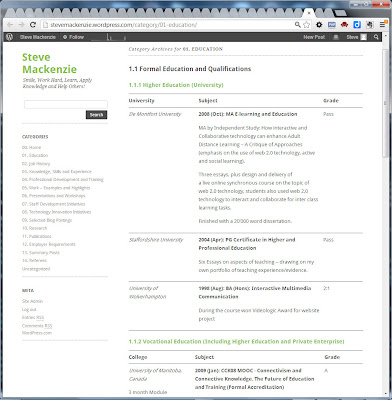 |
| WordPress CV Blog - User View |
The following notes collate the main points that were addressed in our session.
Purpose of this Session
1. Highlight the use of Social media (wordpress) as a medium to organise CV information and Record Personal Development information. It is a career imperative to be organised.
2. Highlight how WordPress (and other blogging platforms) can be adapted and used for many purposes. A Blog is a Blog is a Blog - No! Blog platforms are very flexible and with creativity they can be used for many different things.
Setup and thinking
1. Use this technique with any easily created Blog from http://wordpress.com.
2. No programming skills required.
3. You can make wordpress Private to you! and that was and currently is my intention, whilst i am still building this site.
In any event, the intention is for it to be private, the idea is for you to organize your history, skills and assets in an easily getattable :-) format, in order to customize CV's as appropriate for the job in hand (which generally need to be completed in specific online or offline electronic application forms).
In this process of CV building you can give deeper consideration to the larger projects that you have worked on in your day to day work and use categorisation and tagging to indicate what skills, experience or knowledge they show evidence of. There will also be many smaller day to day skills and many professional developmental sessions that you have attended and that you can easily record in this way.
4. Once finalized the question that can more fully addressed, shall i make it public or parts of it public. Which may be an option, but was not the original intention. In our small discussion the idea was suggested that maybe the CV can be tailored in some way - this is something i will look to consider as i move on and see if there is a feasible way of doing this - I will report back.
Other questions - Can a portfolio of electronic evidence be incorporated or should the portfolio be separate (can be organised using the same approach as i will outline in the following paragraphs).
Worpress Features, how they are used and Useful Strategies.
1. SELECT A THEME that suits your need. I was looking for a very simple theme. i chose Theme: Ari by Elmastudio.
2. CATEGORIES AND TAGGING Tailor the theme so that the only widget displayed is the Category widget. You will be posting various information from your CV as a series of blog posts ORGANISED by category. Tagging can add a further element of organisation and cut across two or more categories. In my current theme I could add a tag cloud widget. I chose not to as i did not like the tag cloud widget, i prefer a list but this was not available. A list widget would probably have changed my mind. Perhaps it is simpler without it anyway (tag links are still listed at the bottom of posts)
3. CREATING CATEGORIES In the Admin view we need to create the CV categories. This can be done at the beginning in the post categories section (you could use the category menu image below which shows my categorization as i guide) or add the categories to the posts as i did whilst i was developing my thinking on how best to order my menu.
 |
| Menu - The ordered list of categories |
If you look at the example menu above you will probably agree that the first four or five categories will be quite standard. From 5-12 you may want to modify these categories to suit your particular circumstance and to clarify and record your skills You may have many strings to your bow e.g. examples of decisive management, examples of fostering positive change, examples of supporting people at work.
4. PRACTICAL TIPS for displaying and working with your CV
i) Use 01, 02.. etc at the start of category titles to order in a way that suits you - easy to change using quick edit. (Facilitates the Alphabetical menu order which you can control)
ii) This next two part tip, combined with the categorisation is probably the MOST IMPORTANT element to make this blogging tool useful for coherent organisation, both from a user view and from an admin view.
Part 1) Visually Number Posts at the start of the post title with the category number and the order within that category that you want. e.g. 7.1, 7.2, 7,3
Part 2) Change the blog post date to order the posts in admin view - each section has a category tag - a category (conceptually) can be assigned a month and year to order posts, posts within a category can be ordered further by the number of days in the month. So if there were two posts in our 01 Education category, I would make sure that both posts were dated March 2013 (previous month ago from the date of this post). Now for the first post i would set the date the March 30 and for the second March 29. Post dates are easily changed using QUICK EDIT.
Thus the posts in admin and user views are now both visually and practically ordered for a coherent working environment.
 |
| Worpress Admin - A post in Quick edit mode with Date, category and Tags highlighted |
5. Might have mentioned this earlier but The PERSONAL DEVELOPMENT element will encourage you to record examples of your everyday work that can be used as evidence to support essential and desirable requirements that you see listed in CV application documents. You can use these requirements to prepare for similar requirements in the future - eventually covering all basis.
 |
| Wordpress - Admin View |
5. OTHER RELATED USES
Can you think how this approach can be harnessed for other uses. I think there could be quite a lot of applications. Possibles:
1. I have already mentioned - Use to build a portfolio either separately or within the CV.
2. As an educational programme builder for a team ( instead of a wiki maybe)
6. EXTRAS That came out of our small group discussion.
1. Good to give Employers the option to peruse through an online CV if they wish. A Paper based version would be overwhelming, but online CV in this manner could be more appealing and make it easier for employers to deleve further if they wanted to.
2. If made public (can be limited to a set few as well) - the comments boxes could be used for endorsements.
7. FINAL THOUGHT
These notes were orginally to support a face to face show and tell presentation. I may try and setup an Dummy Wordpress CV site for anyone interested to get a better picture of how this works.
Sunday, January 27, 2013
MOOCING on Gas: Early Thoughts on Three Concurrent Offerings
Brief Overview of the MOOC Scene
John Mak a long standing and leading analyst in the field of Moocs identifies five different types of Moocs in this article What are the main differences among these types of Moocs. For simplicity and for relevance to this post, i shall identify what i consider to be the three main approaches which are i) primarily an instructivist learning approach ii) primarily a free form distributed approach and iii) primarily a project based approach.
Currently we have a 'perfect' storm whereby all three types are running just about concurrently, we have in order of type as described above i) E-learning and Digital Cultures (#edcmooc) ii) Educational Technology (#etmooc) and iii) Online Learning Design (#oldsmooc). I initially joined up for #etmooc but have since got involved on both of the other courses.
When participating in a MOOC what are you looking for? What are you expecting?
For first timers especially, chances are that you are expecting a pretty structured learning path and this is what you can generally expect from xMooc courses such as those offered by Udacity or Coursera. Both these type of xMooc offerings are geared to a traditional classroom based individual study approach, allowing for the fact that coursera does promote the notions of active learning and peer assessment (see Coursera pedagogy),i'm putting this in the instructivist camp). This on the face of it is the type of offering for the E-learning and Digital Cultures course.
 |
| E-learning and Digital Cultures Course |
However if you sign up to a pure distributed cMooc such as #etmooc things may not be so clearcut. Not withstanding some guiding information about how to work in a cMooc environment you are very much expected to build your own learning environment using social media tools such as twitter, facebook and google plus, wikispaces, diigo etc whilst learning about the subject matter (on learning and technology moocs you will possibly be bombarded with all manner of useful applications (you won't remember everything, but you will learn a lot)).
 |
| Educational Technology and Media Course |
The Online Learning Design (#oldsmooc) cMooc although encouraging the use of distributed social media tools revolves strongly around the in-house socially connective software cloudworks that for the purpose of the course acts in my opinion a bit like a VLE, but does include the ability to connect with all previous registered users ideas and interactions through the vehicle of clouds (individual idea, comments, questions, tasks etc) and cloudscapes (a collection of clouds). Because of the project based nature of the course it does have a community of practice feel to it.
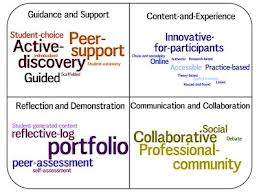 |
| Online Learning Design Course |
Some thoughts on Moocs
The xMoocs have a great role to play in straight forward knowledge transfer and for me the big issue to address is when they may inappropriately be used with a topic that would benefit from more connective, distributive learning type approaches. Effectively they offer a traditional self directed individual study route that may benefit additionally from a cMooc approach but it may not be necessary.
With cMoocs the big question is can you get the connectivity, the distributivity and oxycontinicity ( @angelatowndrow and @trendingteacher inspired language) flowing. Do the learners feel the glow of support, encouragement and eureka moments that will sustain and nourish them in the tough task of being a blogging, connective learner. Are they MOOCing on Gas! Why is this important you ask?
It's important because cMoocs do three main things:
- They first and foremost are developing the lifelong learning skills that an independent self directed learner will need in their future learning.
- They very importantly act as a catalyst to expand and develop the personal learning network and environments that are crucial if a participant is going to flourish as a connective learner.
- It offers the opportunity for an intense period of study of a topic with built in peer support and the consequential vigour and energy that this intensity and support brings.
First Thoughts on ETMooc, EDCMooc and OLDSMooc
ETMooc
I started off by joining ETMooc. Having previously participated in a number of cMoocs namely CCK08, PLENK10 and CritLit10, I thought I knew how this was going to work. But WHAM it seems that there was a change to what i was used to.
Previously i had known a clear weekly structure and access to initial reading and video resources to get one going with your blogging, this time there appeared to be no material to initially work with and this was a bit disorientating. I suspect this was an experiment to get more people to come to the Blackboard Collaborate live sessions where it seems most of the knowledge and information was being transmitted. Reading lists appeared to be accessible via the course social bookmarking sites diigo and delicious. I don't think I have truly recovered from this blow especially since a vibrant alternative suitor came along in the shape of EDCMooc (more about that later).
What has been a good innovation in ETMooc is giving two weeks per topic. So i think a massive thumbs up for that and a massive thumbs down for the initial lack of resources (a warning for old timers might have helped, however it is something that i will be much better prepared for in the future and has not put me off). ETMooc is still in my thoughts and is indeed the prime instigator for this post.
OLDSMooc
I initially liked the idea of a project based task and have got myself aligned to a group, but am not officially in a team mainly because i was late joining and it is hard to play catch up. I think the Cloudworks connective software has some potential but it does feel as though the mentality of the course is more inward looking because of the nature of the team tasks. Although oldsmooc is out there in all the right social spaces i don't believe connectivity wise it has really taken off because it is not a strong component of the learning design philosophy (be interested what the designers think about that), despite the best efforts of @penpln. I am behind with this, but hope to hang in there and fully appreciate the cloudworks environment.
EDCMooc
Phenomenal and the course has not even started. This Mooc is cooking with Gas. Here is the funny thing, the connective cMooc mentality is massively strong on this xMOOC type course and it has nothing to do with the course leaders. So why, what are the lessons. I might be wrong but:
1. Massive lead in time to prepare the social distributive structures to support this informal connective network (2-3 months before course actually started).
2. Attitude of initial leading participants who fortunately had a connectivist mindset. The giving warmhearted attitude has rubbed off. (They have shined a light on the attitude and mindset required to foster cMOOC learning)
3. Clever, not to difficult, not to rigid events and tasks. For example i) Twitter Chat ii) Quad Blogging iii) Draw your thoughts e.g draw a picture of what to expect in this MOOC.
Love it that an xMOOC got cMOOCed - This will obviously bode well for the xMooc which starts officially today.
Final Thoughts
I believe all cMoocs organisers can learn from the EDCMooc to make cMoocs better. Initial Instigators of EDCMooc you deserve a big hats off. I believe that EDCMooc will spawn a bank of cMOOCers that with the long lead in time can and will support other non technology MOOCs and we should try and encourage this emotional expertise that EDCMoocers, ETMoocers and OLDSMoocers have to offer.
to ETMoocers and OLDSMoocers i know that there are many of you with the same emotional expertise, i have highlighted EDCMooc because I believe that there are some very good practices (some by design, some by chance maybe) that could enhance the way Moocs are run in the future.
Ciao!
Saturday, January 26, 2013
Wordpress LMS LearnDash - The greatest LMS in the World?
Well that is what I am betting on for the soon to be released WordPress LMS - LearnDash! Why would I bet on it or make a claim of such largesse when I have not even seen or used it.
First off we know that this LMS is built on the strongest of foundations - The brilliantly devised WordPress blogging platform. This platform is very mature with nearly 10 years of worldwide development and support. The open software architecture has been cleverly devised to allow for useful applications to be added to WordPress through the use of plugins making it very easy to extend the functionality either by installing ready made applications or by developing plugins yourself. In a nutshell we have an easy to use platform for developers, visitors and non-technical editors.

Secondly we have had nearly 14 years to observe the growing pains of modern day web based learning management systems. The LearnDash designers have had all this time to learn from the mistakes and design faults that these systems may have. Although the various current products on offer have varying strengths and weaknesses I cannot believe that many will be as tightly and efficiently coded as a product that is going to fit into the ultra sleek WordPress blogging platform.
As long ago as December 2006 I shared my dismay at mainstream LMS/VLE systems (see Embrace Web 2.0 technology or Die - that's an order!) and advocated the use of web 2.0 technology for ease of communication and thus ease of learning. More recently I really have started to appreciate the power and beauty of WordPress and thus with the launch of a Wordpress LMS - LearnDash this Monday 28th Jan I do believe this could be the launch of the greatest LMS yet.

Photo Courtesy of Ben Sheldon
under the CC BY-NC-SA 2.0 license.
I don't profess to know the full repertoire of features and how they fully work yet but building on the core features of student management, unlimited course creation and the 'Tin Can API' (which captures activities that happen as part of learning experiences),I am particularly looking forward to the easy certificate creation when students pass tests and quizzes, the powerful report generating module and the easy integration with any other WordPress themes and plugin applications.
Tin Can API
It lifts many of the older restrictions. Mobile learning, simulations, virtual worlds, serious games, real-world activities, experiential learning, social learning, offline learning, and collaborative learning are just some of the things that can now be recognized and communicated well with the Tin Can API.
It all sounds promising, looking forward to trying it out soon and keeping my fingers crossed that it truly is going to knock spots off all competitors. If it sounds interesting to you, take a look here for more information WordPress LMS - LearnDash.
Once I start working with it I'll let you know if it lives up to the Hype :-)
Once I start working with it I'll let you know if it lives up to the Hype :-)
Sunday, January 20, 2013
ETMooc - Stevie Italiano
I am using this and my first ETMOOC posting to briefly introduce myself, but more importantly in this blog post introducing the notion of closed captions on videos (easily achieved using Camtasia) and previously i introduced a photo that was made available for use under the creative commons license.
If anyone wants to discuss anything relating to these tool educational tools then please leave a comment. Grazie :-)
If anyone wants to discuss anything relating to these tool educational tools then please leave a comment. Grazie :-)
Friday, January 18, 2013
ETMooc - Moocing old style
As a participant of the first truly massive mooc CCK08, I am looking forward to participating in an old style :-) Mooc (cMooc) as opposed to the newer brand of xMoocs.
After participating in other cMoocs such as PLENK10 and CCK11 I have maintained loose connections with a number of early Moocers but in the last year or so have adopted a more passive (lets say less active) than active approach but I have still made a few spasmodic contributions on the topics of educational technology and connectivist learning and i know that long term i have the mentality of a contributor and so my time to serve will :-) come again.

My participation in this mooc i am hoping will re-awaken the more active connectivist in me.
Let me say that a big hats off to the course creators. I think the two week per topic over 12 weeks is a master stroke in enabling participants the opportunity to keep up with the programme and I think will help enormously with the problem of participants getting disheartened when they cannot keep up with the schedule.
After participating in other cMoocs such as PLENK10 and CCK11 I have maintained loose connections with a number of early Moocers but in the last year or so have adopted a more passive (lets say less active) than active approach but I have still made a few spasmodic contributions on the topics of educational technology and connectivist learning and i know that long term i have the mentality of a contributor and so my time to serve will :-) come again.

My participation in this mooc i am hoping will re-awaken the more active connectivist in me.
Let me say that a big hats off to the course creators. I think the two week per topic over 12 weeks is a master stroke in enabling participants the opportunity to keep up with the programme and I think will help enormously with the problem of participants getting disheartened when they cannot keep up with the schedule.
Tuesday, November 27, 2012
Beginners Guide to WordPress: Setting up a local site, Setting up a working development environment, Gaining practical skills and Developing understanding
Before we move onto the central theme
of this article, as a foundation to our knowledge I suggest you read this
article which outlines the different versions of WordPress that are available: http://lorelle.wordpress.com/2005/08/27/wordpress-versions-how-many-and-whats-the-diff/
As individual developers we are concerned with the
full version of WordPress. For
individual developers that are learning their trade or who need access to an
environment where they can experiment and practice without the additional
issues of acquiring web space and a web server we need a local web server
installed that will replicate the online web space where WordPress would
normally be housed. There are a couple of solutions listed below. I suggest you
try out both options i) to see what environment you like working in the most
and ii) give you the opportunity to work on a couple of WordPress sites as you
experiment in the future.
·
Have a read of section 1 for some background to
the technology
·
Try both implementations in section 2. You may
want to go to section 3 before you start and download WordPress. Instructions
will then be given in section 2 on how to install this onto your local web server.
·
Section 4 will give tips on using Dreamweaver as
your development environment. If you do not have Dreamweaver links to other
options are provided.
·
In section 5 we get down to work by creating a WordPress
theme.
·
Section 6 Plugins, you will not really need at
this stage, but it is there for future reference
·
Section 7 offers some thoughts on development Strategies,
Environments and Tools
·
Section 8 offers links to websites that can help
with the development of individual LAMP technology programming skills.
·
And in section 9 some other useful resources are
listed.
I. Background to the Technology
1. Understanding LAMP: http://www.serverwatch.com/tutorials/article.php/3567741/Understanding-LAMP.htm
II. Setting up the Local web server Infrastructure
(XAMPP)
2a. XAMPP Home http://www.apachefriends.org/en/xampp.html
(This link is for an overview of product)
3a Download XAMPP (v1.8.1) http://www.apachefriends.org/en/xampp-windows.html
(includes Apache web server v2.4.3, PHP
programming language v5.4.7 and MySQL database v5.5.27 and phpMyAdmin 3.5.22 :
(probably best to use the installer option. Note also there is Lite version for
use on USB Sticks)
4a How to Setup a WordPress Development Environment
for Windows (XAMPP): http://wp.tutsplus.com/tutorials/how-to-setup-a-wordpress-development-environment-for-windows/
OR
II. Setting up the Local web server Infrastructure
(WAMPSERVER)
2b WampServer Home http://www.wampserver.com/. (This link is
for an overview of the product. The product is made by a French company, use
the ‘ENGLISH’ text link on the home page to translate the page, not the browser
translate option if prompted.)
3b DOWNLOAD WAMPSERVER 2.2E. From the Home page there
are a range of installation options depending on your computer and the specific
versions of Apache, MySql, PHP and phpMyAdmin.
If you intend transferring an existing php intensive WordPress
site into this setup it is probably best to match your existing versions.
You get the choice of 32 bit or 64bit depending on
your machine. You can find this out by looking of the properties of your
‘computer’ or ‘my computer’ icon on your desktop (right click).
When downloading you will be presented with a form to
fill in(for training) – you don’t need to fill this in, you will find a link to
download the file at the top of the page. I went for this version (64-BIT &
PHP 5.3) as it matched my machine and the PHP version matched a WordPress site
I was transferring in.
4b. Setting up a local server for WordPress
development (WAMPSERVER): http://www.webdesignerdepot.com/2012/02/setting-up-a-local-server-for-wordpress-development/
III.
Installing WordPress
5. Download WordPress: http://wordpress.org/download/
6. Installing WordPress: http://codex.wordpress.org/Installing_WordPress
IV. Working with WordPress
7. Setting up a PHP Development Environment: http://www.adobe.com/devnet/dreamweaver/articles/setup_php.html
The article gives a comprehensive overview which includes installation of XAMPP
and myPHP admin as they are critical to being able to progress when setting up
your Dreamweaver development site. Instructions included for both MAC and
windows users. If you have already
installed XAMPP you may just want to review the instructions. The Dreamweaver
action kicks in with the section “Defining a PHP site in Dreamweaver CS5” and
finalises the whole download , installation and development setup to get you
ready just to focus on the development of the WordPress website.
8. Other Development Environment options include:
·
WordPress development with Netbeans IDE: http://www.dev4press.com/2012/tutorials/wordpress/wordpress-development-with-netbeans-ide/
I have not used any of these but all have been
mentioned in dispatches as useful development environments.
V. Getting to Work – Themes
9. Using Themes: http://codex.wordpress.org/Using_Themes
10. Theme Development: http://codex.wordpress.org/Theme_Development#Template_Files_List
11. Intro: How to build a WordPress theme from scratch: http://www.developerdrive.com/2011/10/how-to-build-a-wordpress-theme-from-scratch-part-one/
12. More in Depth: How to create a WordPress theme: http://themeshaper.com/2012/10/22/the-themeshaper-wordpress-theme-tutorial-2nd-edition/
VI Getting to Work – Plugins
13. Plugin Development for WordPress: http://www.developerdrive.com/2012/05/plugin-development-for-wordpress/
VI DISCUSSION – Strategies, Environments and Tools
14. Professional WordPress Development
Strategies: http://wp.tutsplus.com/articles/general/professional-wordpress-development-strategies/
15. Professional WordPress Development environments: http://wp.tutsplus.com/articles/general/professional-wordpress-development-environments/
16. Professional WordPress Development tools: http://wp.tutsplus.com/articles/general/professional-wordpress-development-tools-2/
VII Skill Development
17. PHP 101: PHP For the Absolute Beginner: http://devzone.zend.com/6/php-101-php-for-the-absolute-beginner/
18. CSS Tutorials: http://www.csstutorial.net/
19. JavaScript tutorials: http://www.pageresource.com/jscript/
VIII Useful Other Resources
DEVELOPER Drive: http://www.developerdrive.com/
How jQuery Works: http://docs.jquery.com/How_jQuery_Works
Friday, May 25, 2012
Camtasia 7.0 Part 1: Key Preparation
This post is the first in a series that will shed light on my approach to developing a videocast. In particular what i would call a video 'infocast'.
This post mainly draws on my experience of developing a set of videocasts that introduce students to 'online and distance learning' (See parts 1,2,3,4,5,6) at the University that i work DMU.
1. Split your project up into approx 5 minute videos. There will be research around that indicates that 5 minutes is at the outer limit of time that people will set aside to concentrate on watching a videocast. In my own particular project I ended up with about 6 videos. One video did stretch to 7 minutes, but i personally think in the context of 5 other shorter videos of between 2-5 minutes, then slightly breaking the rule but keeping the breaks natural was ok to do (I say - follow guidelines but don't be afraid to break the rules). 2. Store and Work on a USB Memory Stick. One of the few poor things about Camtasia is that when you add Media to the project it only refers to the media using the original absolute file path and location. If you wish to move your folder somewhere else or if you want to work on your project at home and also at work you will have to re-find the media everytime you change locations before you can start working on the project. To get around this problem you need to store all your work on a USB Memory Stick, keep a consistent folder structure and make sure that whatever machine you work on assigns the same drive letter to your USB Stick. This article explains how to Assigning a Drive letter to a USB drive. For me as the work machine forced me to use a G:/ Drive, I reassigned my own drive at home to match up and ensure i could work on both machines with no problem should i have to.
3. Set up a clear working folder structure. There are lots of different types of files that may be used when developing a Camtasia project. In order to work in a methodical, stress free way it pays to get your working folder structure clearly organised before you start. In the Development of this series of online and distance learning videocasts my preferred working methodology was as follows:
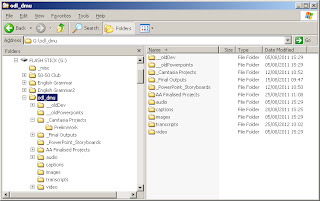 A. i) Create a "_Camtasia projects" folder to save the project file and any iterations thereof. ii) Create a "_Final outputs" folder to store the many variations of output that you may experiment with during the production process e.g. 480x360px screen size versus a 320x240px. iii) Create a "_Powerpoint storyboards" folder to store the powerpoint file (and any iterations thereof) that i use to build and develop my ideas. iv) Create a "AA Finalised projects" folder to store the completed series of videos that will be ready for distribution. v) Create "audio, images and video" folders to store the various media that may be used and finally vi) Create a "transcript" folder to store your transcripts and vii) Create a "caption" folder to export finalise audio text captions for use with closed captioning.
B. Plan and map out the sequence of the video using Powerpoint. This allows me to use individual slides (save as > other format - jpg files) as graphic images in the videocast and for me to use the notes section of a powerpoint slide to write and then perfect the initial audio transcript. I can print the slides (publish > create handouts in microsoft word) with the transcript for reference when delivering voiceover narration.
C. Develop and use Other media (audio, video, graphics) as appropriate and save in clearly labelled media folders.
D. Experiment if necessary by producing a final output to the "_Final outputs" folder. This a test folder to see various output options in action.
E. When final output format is finalised then save in "AA Finalised projects" folder.
4. Use Audacity to create and Edit Audio narration files. You can record audio narration files quite happily from within camtasia (saves in a .WAV format). Audacity is just very quick and easy for recording and editing short narrated files. Additionally you can output in the .MP3 format. (although you need to install an extra file - the LAME MP3 Encoder). You can get away without audacity but i consider it a tool that makes your development easier and gives you more flexibility (you can use with other applications, once you know how it works).
5. Settings for best quality video on youtube This article explains in depth how to prepare video for youtube: How to Make YouTube Videos Look Great. The key thing seems to be to use the 16:9 ratio and set to dimensions that are equal to 480x360 or same aspect ratio, as youtube finalize videos at 480x360px. Especially if I need to do screen capturing I now tend to use 960x720 to keep the ratio the same (but i did not do this for these videos). Note: I am still experimenting with this and have not come to a definitive view on what the best strategy is, but at this time this is my position.
Late Update
6. If recording is slow Disable Display Acceleration During Capture. I noticed that initially especially with PowerPoints capturing a screen recording can be very slow. by disabling the display acceleration during capture recording speeded up dramatically. Read this link on How to Improve Recording Performance for a full explanation and other related tips.
So this is an insight to one particular project that I have worked on - there are other ways of using camtasia, but hopefully this gives an initial idea of the things to think about when setting up. note: looking back I will probably review my naming conventions - the underscores and "AA" in the folder names was to keep these folders together away from the media folders, so that I could find the media folders more easily when in the middle of working.
Photo Courtesy of elibrody under the CC BY-NC 2.0 license.
To ensure that you do not waste unneccesary time, there are six key things you need to do before you embark on your project. These are:1. Split your project up into approx 5 minute videos. There will be research around that indicates that 5 minutes is at the outer limit of time that people will set aside to concentrate on watching a videocast. In my own particular project I ended up with about 6 videos. One video did stretch to 7 minutes, but i personally think in the context of 5 other shorter videos of between 2-5 minutes, then slightly breaking the rule but keeping the breaks natural was ok to do (I say - follow guidelines but don't be afraid to break the rules). 2. Store and Work on a USB Memory Stick. One of the few poor things about Camtasia is that when you add Media to the project it only refers to the media using the original absolute file path and location. If you wish to move your folder somewhere else or if you want to work on your project at home and also at work you will have to re-find the media everytime you change locations before you can start working on the project. To get around this problem you need to store all your work on a USB Memory Stick, keep a consistent folder structure and make sure that whatever machine you work on assigns the same drive letter to your USB Stick. This article explains how to Assigning a Drive letter to a USB drive. For me as the work machine forced me to use a G:/ Drive, I reassigned my own drive at home to match up and ensure i could work on both machines with no problem should i have to.
3. Set up a clear working folder structure. There are lots of different types of files that may be used when developing a Camtasia project. In order to work in a methodical, stress free way it pays to get your working folder structure clearly organised before you start. In the Development of this series of online and distance learning videocasts my preferred working methodology was as follows:

B. Plan and map out the sequence of the video using Powerpoint. This allows me to use individual slides (save as > other format - jpg files) as graphic images in the videocast and for me to use the notes section of a powerpoint slide to write and then perfect the initial audio transcript. I can print the slides (publish > create handouts in microsoft word) with the transcript for reference when delivering voiceover narration.
C. Develop and use Other media (audio, video, graphics) as appropriate and save in clearly labelled media folders.
D. Experiment if necessary by producing a final output to the "_Final outputs" folder. This a test folder to see various output options in action.
E. When final output format is finalised then save in "AA Finalised projects" folder.
4. Use Audacity to create and Edit Audio narration files. You can record audio narration files quite happily from within camtasia (saves in a .WAV format). Audacity is just very quick and easy for recording and editing short narrated files. Additionally you can output in the .MP3 format. (although you need to install an extra file - the LAME MP3 Encoder). You can get away without audacity but i consider it a tool that makes your development easier and gives you more flexibility (you can use with other applications, once you know how it works).
5. Settings for best quality video on youtube This article explains in depth how to prepare video for youtube: How to Make YouTube Videos Look Great. The key thing seems to be to use the 16:9 ratio and set to dimensions that are equal to 480x360 or same aspect ratio, as youtube finalize videos at 480x360px. Especially if I need to do screen capturing I now tend to use 960x720 to keep the ratio the same (but i did not do this for these videos). Note: I am still experimenting with this and have not come to a definitive view on what the best strategy is, but at this time this is my position.
Late Update
6. If recording is slow Disable Display Acceleration During Capture. I noticed that initially especially with PowerPoints capturing a screen recording can be very slow. by disabling the display acceleration during capture recording speeded up dramatically. Read this link on How to Improve Recording Performance for a full explanation and other related tips.
So this is an insight to one particular project that I have worked on - there are other ways of using camtasia, but hopefully this gives an initial idea of the things to think about when setting up. note: looking back I will probably review my naming conventions - the underscores and "AA" in the folder names was to keep these folders together away from the media folders, so that I could find the media folders more easily when in the middle of working.
Subscribe to:
Posts (Atom)