Join Learnadoodledastic Mailing List

Enter your email address:

Delivered by FeedBurner

Subscribe to RSS Feeds

Subscribe in Bloglines

Add to Pageflakes

Add to   Google Reader or Homepage

Useful Website Links

Showing posts with label Open. Show all posts

Tuesday, April 23, 2013

Are you participating in MOOC or a Massive Online Course acting as a MOOC

The Background

It started with this tweet:
  MOOC-the M in Massive should be viewed as an aspiration and uncontested, If not truly Open, then it is not a MOOC.
in conversation I quickly followed up with this tweet:
  If it's not truly Open, its a MOC, and further more it is making a MOCERY of MOOCS :-)
I have been encouraged to explain my thinking a bit further by Vanessa Vaile, an online friend and valued member of my personal learning network, so In relation to the tweets and the blog post title here we go.

Brigham Young University faculty survey seeks to advance open education through academic libraries
Image Courtesy of opensourceway under the CC 2.0 SA licence

Some More Background

To be absolutely accurate it started with me perusing the Academia and the Mooc MOOC discussion board (Running from the online learning platform, Canvas) and observing a discussion around "is MOOC the right name to explain what you are participating in when involved in a MOOC". At the same time i was reading the JISC CETIS document on "MOOCs and Open Education: Implications for Higher Education" (pages 4-5) which explains the origins and subsequent labelling of recent online course initiatives.
"Following on from the development of Open Education Resources and the Open Education movement (Yuan, et al., 2008), the term Massive Open Online Courses (MOOCs) was first introduced in 2008 by Dave Cormier to describe Siemens and Downes’ “Connectivism and Connective Knowledge” course. 
This online course was initially designed for a group of twenty-five enrolled, fee paying students to study for credit and at the same time was opened up to registered only learners worldwide.  As a result, over 2,300 people participated in the course without paying fees or gaining credit (Wikipedia, 2012).
In 2011, Sebastian Thrun and his colleagues at Stanford opened access to the course they were teaching at the university, “Introduction to Artificial Intelligence”, and attracted 160,000 learners in more than 190 countries (Wikipedia, 2012).  
Since then, MOOCs have become a label for many recent online course initiatives from institutions, individuals and commercial organisations."
In this same document (page 6) the following paragraph grabbed my intention:
"The original aim of MOOCs was to open up education and provide free access to university level education for as many students as possible.  In contrast to traditional university online courses, MOOCs have two key features (Wikipedia, 2012):
1.    Open access - anyone can participate in an online course for free
2.    Scalability - courses are designed to support an indefinite number of participants
However, these features may be interpreted differently by different MOOC providers; some MOOCs are massive but not open and some are open but not massive."
Some even More background

Those that know me will know that I am a strong advocate of connectivist learning. I believe that participation in cMOOCs is a fantastic opportunity to not only learn but to also build and enhance a lifelong personal learning network for ongoing future connectivist learning.

I think we can all agree however that is more than one way of learning. I fully appreciate the need for different learning approaches for different people, situations, and levels of development including transmission mode teaching and learning. xMOOCs are often characterized as transmission mode style of learning and there is no doubt that thousands of learners have benefited from participating in these courses just as have thousands benefitted from leraning in cMOOCs. The exercise played out on this blog post is purely a discussion of the terminology related to MOOCs and by extension the relevance and significance in relation to "cMOOCs" and "xMOOCs".

The Nub of it

The Nub of this post simply started with a deeper look at the language that describes a genuine MOOC. Looking at the The JISC CETIS paragraph citing the original aim and then especially the phrase some MOOCs are massive but not open and some are open but not massive." I came to these conclusions.

Massive - It is an aspiration and therefore it can be legitimately used by anyone describing their course.
Open -     if it's not truly Open, its a MOC and i am afraid not really a MOOC. More on 'Open' below. 
Online -   This is self evident
Course -  I take the 'Course' description to give participants a sense of time, to engender some urgency, to indicate some purpose. Other suggested options mused in the canvas discussion 'defining and redefining MOOC' include classrooms, conversations and communications. These for me do not conjure up the same sense of urgency and purpose.

Being Open- Conclusion

In the JISC CETIS quote above it states that Open access means "anyone can participate in an online course for free", but in the true spirit of the original MOOCs this extended explanation from Dave Cormier gives a more complete explanation of what open actually means.
"Open in the sense that all of the work gets done in areas that make the work accessible for people to read and reflect and make comment on.

The course is open in the sense that you can go ahead and take the course without paying for it
you might pay for getting credit from the institution, but you are not paying for participating in the course.

It's also open in the sense that the work done in the course is shared between all the people taking it. The material put together by the facilitators, the work done by the participants it's all negotiated in the open. You get to keep your work and everyone else gets to learn from it."
An important element for me is keeping your work and it's not that you are just keeping it, but the effort in producing your own work in your own space is good for you as a learner - A place where you can easily retrieve your learning to be referred to and passed on easily again and again when required either directly by yourself or randomly because your work is out there to be shared long after the 'course' has gone.

So after mulling over the language and the terminology associated with the Term MOOC, it dawned on me that if the course is not truly open then it is not a MOOC which it could be argued that some xMOOC offerings may come into this category and in affect they are in fact just a MOC, a Massive Online Course, which chimed in nicely with a blog post by@whitneykilgore xMOOC or New Publishing Paradigm? So
 if not a MOOC or a MOC maybe a new publishing paradigm!

When you look more closely at the words and the meaning and the original aim of a MOOC you logically come to the conclusion that cMoocs by their nature are true MOOCs.

See More From Dave Cormier below in "What is a Mooc"


See also George Siemens' interview on MOOCs and Open Education


See also Welcome to the Brave New World of MOOCs (Massive Open Online Courses)

Saturday, May 05, 2012

Making a case for creating Open Educational Resources for use in Higher Education

To set the scene we'll start with a useful and pragmatic definition of Open Educational Resources from Stephen Downes (although he does not support the idea of an 'official' definition) – Read more here http://halfanhour.blogspot.co.uk/2011/07/open-educational-resources-definition.html
"Open educational resources are materials used to support education that may be freely accessed, reused, modified and shared by anyone."

Background

Inspiration for this post was attendance at the one day MEDEV workshop From curiosity to confidence: sharing what it takes to ‘go open’ with learning and teaching resources. Keynote speaker Kieran McGlade (Queen’s University Belfast) kicked off proceedings with an Introduction to open educational resources (OERs) and open educational practice (OEP). Megan Quentin-Baxter (MEDEV) and Jane Williams (University of Bristol) prompted useful discussion not just on copyright issues in relation to OERs but also on the very important ethical question of consent (i.e consent of lecturers, participants and patients for the re-use and distribution of OERs).

Brigham Young University faculty survey seeks to advance open education through academic libraries
Image Courtesy of opensourceway under the CC 2.0 SA licence

Sangeetha Rajoo and Caesar Wek (Both, Queen Mary University London) demonstrated the good work that they have done creating open educational resources and outlined their approaches and the issues that they have come across. In the final session of the morning Paul Scott (Hull York Medical School) gave an important insight into institutional approaches to developing OERs, emphasizing the importance of planning early from the beginning to ensure all resources do not infringe copyright and that consent is obtained before the creation of resources.

Suzanne Hardy (MEDEV) rounded off the session in the afternoon with many practical tips and advice on tools to use that will aid the development of OERs.

Further Reading

With a business hat on one of the prime motives quoted to justify the creation of OERs is that it is good marketing for the institution and it allows the institution and/or the individual to showcase their skills and knowledge, enhance their reputation and encourage students onto the standard regular courses and programmes that are offered. This may be so, however I have not been overly convinced about the cost effectiveness and sustainability of this approach for the institution and the effectiveness of OERS in being re-used and re-adapted for teaching and learning.

To help improve my understanding and come to an effective rationale to make the case for creating Open Educational Resources for use in Higher Education and beyond I’ve also recently read two articles on the topic. i) Positioning the OER Business Model for Open Education and ii) Extending the Territory: From Open Educational Resources to Open Educational Practices.

Accepting there are merits in the motivation mentioned above, for me it is not yet clear if this alone is a strong enough basis for a Strong OER commitment that fits into the overall strategy of a Higher Education institution and further how it fits in with the notion of still trying to gain competitive advantage over other Institutions who you are collaborating with in a spirit of altruistic educational endeavour. I probably need to examine in more detail the philosophy and ‘success’ of an institution like MIT with their renowned open courseware (OCW) programme (See MIT’s Presidents message about OCW), but attendance at the workshop combined with the further reading has helped me to crystallize a number of reasons that will help make the case for institutional backing for creating and developing open educational resources for use in Higher Education.

The First Argument

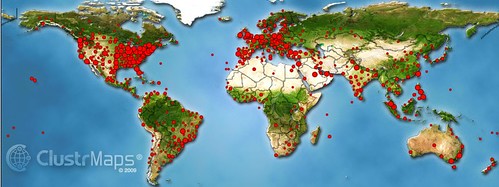
The first argument is that as a leading educational institution it is in the public good to share knowledge globally for the benefit of citizens of the world. To quote Susan Oldfield from the MIT OCW website “We do not yet know the full potential of OCW and its ultimate impact on global education. But it is clear to us that by thinking of knowledge as a public good for the benefit of all, and acting on this philosophy through OpenCourseWare, we can make a difference”.

Clustr Map for the Global Education Collaborative Community 11.28.2009 Image Courtesy of elemenous under the CC 2.0 SA licence


The early pioneers had an obvious passion for this and for many others they may just need some encouragement by other practising colleagues to convince them that contributing to global education is a wonderful thing.

To stiffen this mentality up it could be argued especially in the UK that given that lecturers and the institution are funded in large part by the public purse then lecturers are honour bound to spread their educational resources to the wider public.

Belief in the value of Open Educational Practice is the Key

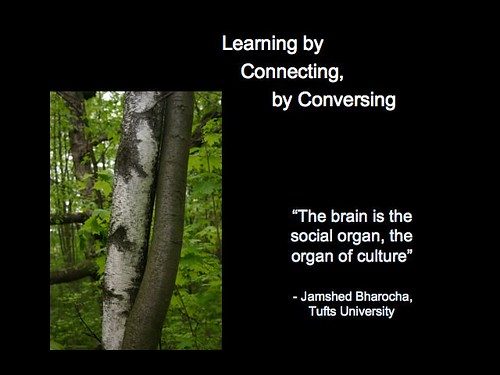
Open Educational Practice when defined is often closely intertwined with Open Educational Resources, for me it is much wider than that. It is sharing and engaging widely and openly. It involves network learning and making use of all the wonderful social networking tools at our disposal to engage and connect with other people on a local, national and global basis. This video Community as Curriculum and Open Learning from Dave Cormier and this video Networked Student from Wendy Drexler best help to explain the concept.

UNH Talk Slide17 Image Courtesy of bgblogger under the CC 2.0 NC licence

Many individual lecturers in Higher Education especially at this time may question the mentality of embracing an open educational ethos and making resources that they create free, open and available for use and re-use by both teachers and students. To persuade unconvinced staff, to me it is essential that staff first buy into the notion of open educational practice. Once convinced, the notion of creating open educational resources will naturally become part of the open educational mindset.

Having myself been exposed to the open educational concept primarily through the great connectivist movement (see what is connectivism?)  my own sharing behaviour has been changed as I have been convinced by the enlightened early believers of the merits  of being an active participant in a wider national and international open learning community. The massive educational benefits I have freely received has encouraged me to contribute my own knowledge skills, ideas and opinions freely and openly thus playing my part in helping others, as others have helped me.

We need to emphasize that the materials are free and open in the context of education and are for non-commercial gain with you the creator maintaining control of all aspects of copyright including accreditation and sharing and re-use restrictions. This is ideally done using a Creative Commons license, but part of the preparation will include ensuring all material used has no copyright restrictions and that ethical, moral and legal consent for the inclusion of third parties in for example video resources is obtained.

Mitigating the effort of creating OERs

I question the cost effectiveness and the sustainability because it is not monetarily cheap to produce sophisticated specific resources or timewise cheap to adapt and prepare materials for use as an OER. However, if you are persuaded by the need to act in the public good, the obligation to make the most of your publicly funded time or you really can see the massive advantages of giving and receiving open educational resources and sharing knowledge and ideas as part of a global education community, then with some preparation and clear intent at the outset the job of creating OERs for use in your regular teaching and learning and then for further sharing and re-use can be made easier in a number of ways. Consider the following:

1. Within most Higher Education institutions there will be an OER Champion. It will be important to work with them and within your own institutional guidelines and policies. There are many legal and ethical issues to consider. Your OER Champion mindful of the circumstances at your institution will be able to offer time saving guidance and advice and possibly a clear checklist of things you need to do to prepare resources for open educational use.

2. Addressing key legal and ethical issues mentioned above before starting development of an OER will include i) ensuring that you are the copyright holder or that you have copyright clearance to offer certain material  within an OER ii) clearly stating the terms upon which you as copyright holder will allow the OER to be used, shared or re-used (a creative commons license makes this a simple process) and iii) gaining consent of participants in OERs before creation of said OERs (and with a clear explanation as to its purpose and use).

3. With an OEP mindset you’ll be more inclined to take advantage of OERs produced by others. Your eyes will be opened to a wealth of material freely available. This will inspire you to understand what is possible and encourage you to contribute yourself when the time is right.

4. There are many free tools out there to help not only the development of OERs but resources for your own regular teaching and learning. Once again opening your mind to these tools will further encourage you to understand that with good planning and preparation making resources available freely and openly for use and re-use although requiring some effort may not be too onerous a task.

Practical Help

During the MEDEV workshop Suzanne Hardy signposted some great tools for sourcing open educational resources during the workshop.  Some useful tools highlighted are listed here.

OERs in Action

Here are a couple of useful examples of OERs that i am familiar with:

And Finally Dissemination

There will be many OER Repositories such as Jorum to upload your resources too, but if you want to try and spread the word about your OERs far and wide this search engine optimisation guidelines article by Dr Vivien Rolfe and Dr Simon Griffin uses the DMU Sickle Cell Anaemia project mentioned earlier to illustrate a step by step approach to gaining maximum exposure for your resources.
PS:If you don't know where to start with connectivist teaching and learning, contact me and i'll suggest a suitable starting point.

Add me to your network

Lijit Search